Googlebook makes Local Desktop more useful 💻

Googlebook is coming in fall 2026. Google calls it a new kind of laptop designed for Gemini Intelligence, with features like Magic Pointer, Cast My Apps, and Quick Access. In plain words: Android is moving toward laptops.
This is a huge validation of what we have believed from the beginning: Android devices are not just phones. They can be real computers.
Googlebook is not only about AI. The interesting part for us is that Google is putting Android closer to the laptop form factor. The official page says Googlebook can open phone apps on the laptop with Cast My Apps, and can access phone files with Quick Access. The footnote also says these phone-connected features require a phone with Android 17 or above.
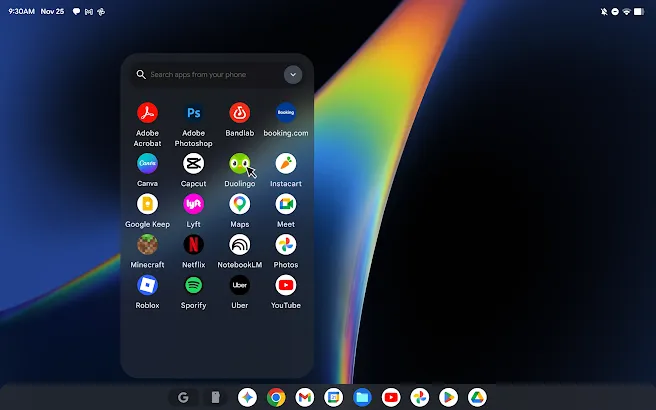
Cast My Apps on Googlebook. Source: googlebook.google
TechCrunch reports that Acer, Asus, Dell, HP, and Lenovo are working with Google on the first Googlebooks. WIRED describes Googlebook as an Android-centered laptop platform, while also noting that it is not meant to replace Chromebooks for now.
So are we getting sherlocked again?
Maybe a little. And again, I am delighted.
The more Google pushes Android into laptop workflows, the more normal it becomes to expect a mouse, keyboard, windowed apps, a real filesystem, and long working sessions from Android hardware. That helps Local Desktop. It changes the question from:
"Why would anyone run a Linux desktop on Android?"
to:
"Which desktop workflows can Android handle?"
Local Desktop still matters because Googlebook will not instantly make every Android device a full laptop. It is a new product category, coming later this year, likely with new hardware requirements and a premium focus. Local Desktop is for the devices people already have: tablets, phones, foldables, old devices, cheap devices, and unusual devices from brands that may never ship a Googlebook.
It also matters because Android laptop support does not automatically mean Linux desktop freedom. Developers, students, power users, and tinkerers still need tools like VS Code, Firefox, GIMP, terminals, package managers, and full desktop environments. Local Desktop is about giving people a local Linux desktop on Android, without waiting for one specific vendor, one specific device line, or one specific Android version.
If Googlebook succeeds, manufacturers will build better Android laptop hardware. Users will ask for better desktop apps on Android. Developers will take large-screen Android more seriously. And projects like Local Desktop will have a much bigger audience: people who already understand that Android can be a computer, but want more control than the default experience gives them.
That's the best possible future for us.
Please star our GitHub repository and follow our adventure.